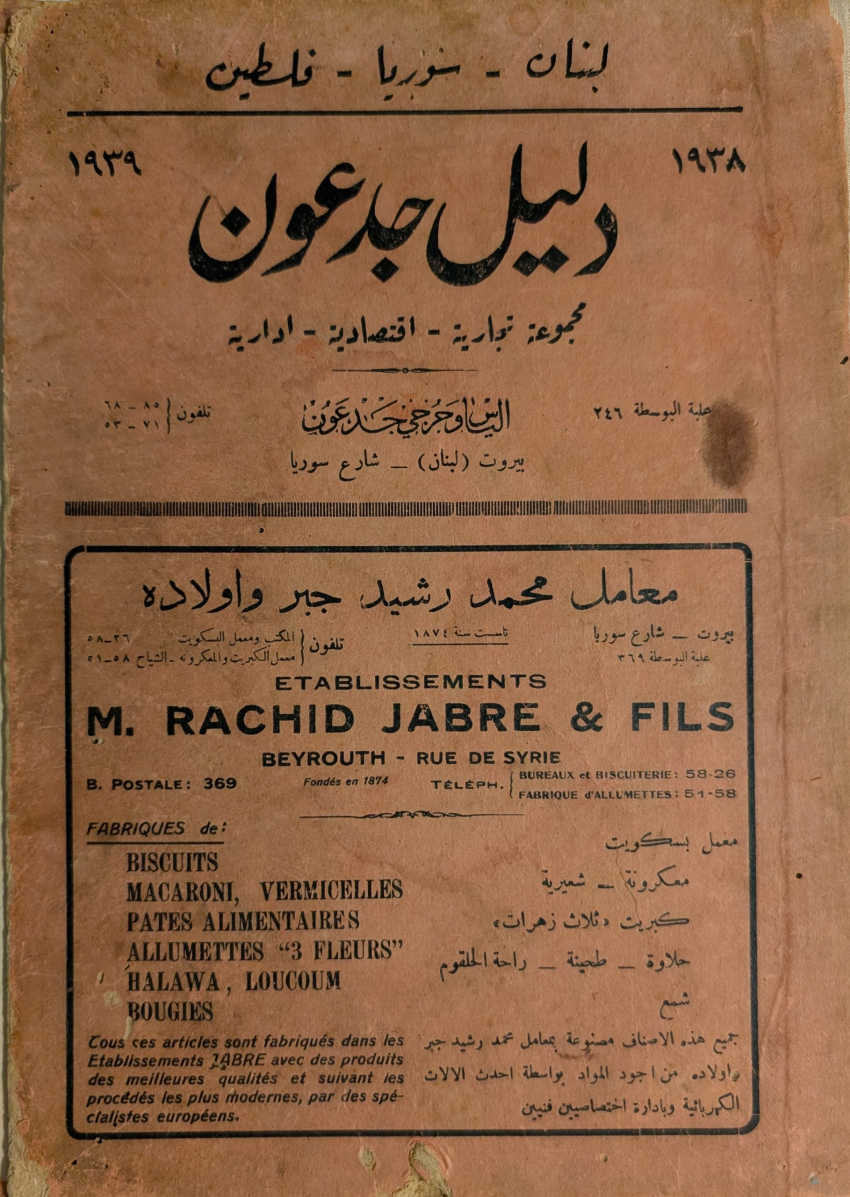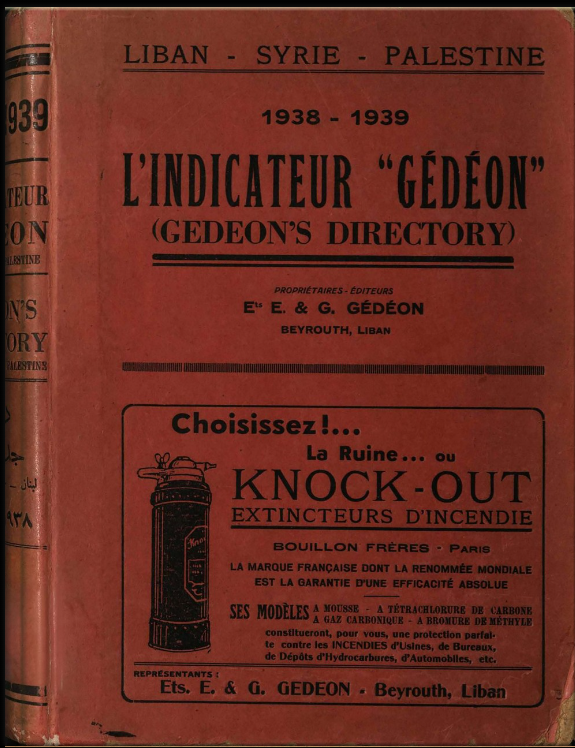
The 61st Venice Biennale International Art Exhibition on the theme In Minor Keys (9 May – 22 November 2026) presents the works of 110 artists, including an installation by the Israeli film maker Avi Mograbi. Titled Between a River and a Sea, the installation is partly based on Mograbi’s film Once I Entered a Garden (2012), in particular on the 1938 edition of a guidebook called the Gedeon’s Directory (Dalil Jad’oun in Arabic).
The Dalil is a bilingual (French and Arabic), voluminous tome of 878 pages. It contains information on cities and towns, sites, the economy and businesses in three neighbouring countries: Syria, Lebanon and Palestine. At the time, the borders between these countries enabled free passage of people and goods. Thus, even as the Great Arab Revolt (1936-1939) against the oppressive British Mandate authorities was unfolding in Palestine, the guidebook’s Arabic section provides listings for Arab, Jewish and mixed towns such as Jerusalem, Tel Aviv, Jaffa, Haifa, Acres, Bethlehem, Gaza, Hebron, Lydda, Nablus and Ramat Gan. The French section also includes places such as Petah Tikva, Nazareth, Jericho, Hadera, Rehovot, Ramallah, Bnei Brak, Safed and Ramle.
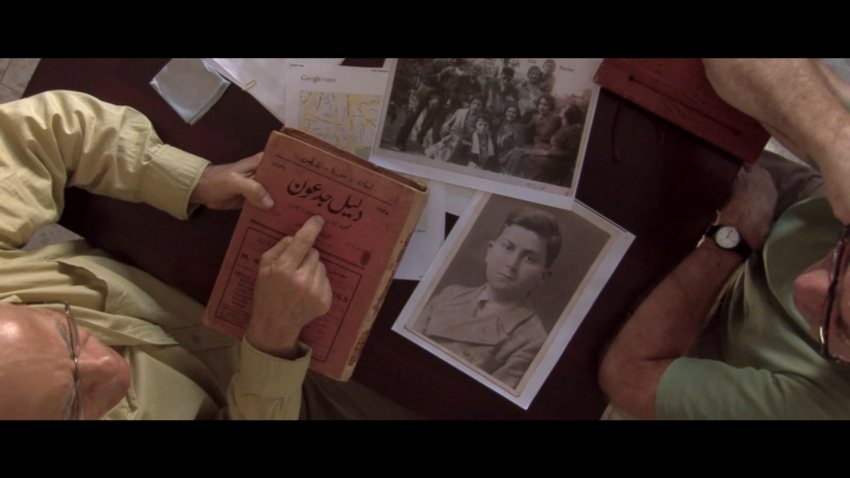
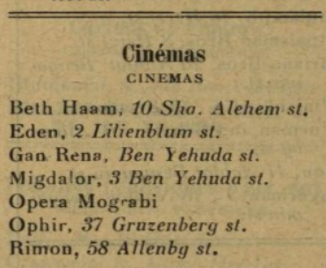
The film Once I Entered a Garden depicts a partly imaginary journey through space and time, encompassing these three neighbouring countries. Avi Mograbi embarks on this journey accompanied by his friend (and Arabic teacher) Ali Al-Azhari. In one of the first scenes in the film, Ali takes out a copy of the 1938 guidebook that once belonged to his father. The two friends leaf through the book, looking for listings of the Mograbi family’s businesses. Avi’s father, Gabriel Mograbi, born in Beirut, was a co-owner of Opera Mograbi in Tel Aviv. Opened in 1930, the venue comprised a cinema and a theatre. The building burnt down in 1986 and was subsequently demolished, but had it survived the fire, it would have been destroyed by an Iranian missile which hit its very location in June 2025…
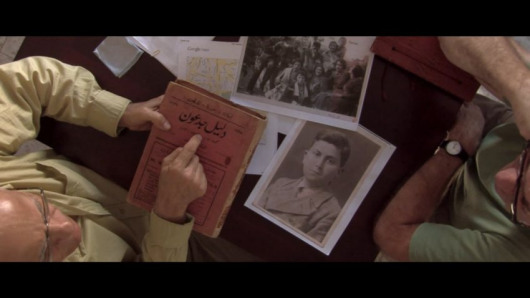 Ali Al-Azhari (left) and Avi Mograbi leaf through the Dalil
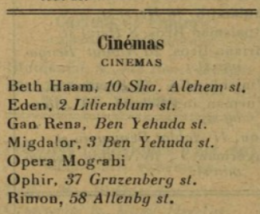 Opera Mograbi, Tel-Aviv
The journey takes the two friends through landmarks in Avi’s family’s life, from Damascus to Beirut to Tel Aviv, as well as in Ali’s life, from his native village Saffuriyeh, which was occupied by the Israeli army in 1948 and all its inhabitants (including baby Ali) expelled, to Tel Aviv and Jaffa, where he has been living since the early 1970s. In the film, the imaginary journey to the multi-faith, multi-ethnic society which existed in the region during the pre-Nakba, pre-Israeli State era is constantly shattered against harsh reality, while recalling the unfulfilled aspirations for a common future for all people and all peoples who live there.
Matzpen – an organisation Ali joined in the mid 1970’s – not only aspired to bring about the recognition of the legitimate rights of the Palestinian people, including the right of return of Palestinian refugees, but also aimed for a revolutionary change in the entire Middle East which would topple all existing regimes and replace them with a regional socialist union, where the personal and collective rights of all minorities, including the Jewish-Israeli people, would be respected.
In his Biennale installation, Mograbi juxtaposes browsing the 1938 Dalil Jad’oun with a contemporary equivalent: a search in the 2023 Gaza digital business directory. The latter, too, is a memorial to lives destroyed and buried under a barrage of Israeli bombs and the claws of their bulldozers.
*
Click here to watch the film Once I Entered a Garden.
Click here to browse Dalil Jad’oun (This will take you to the title page of the French section of Dalil Jad’oun. To go directly to the Arabic section, click the right-pointing arrow at the bottom of the page).