

[A conversation between Sophia Deeg and Khalil Toama, which took place in 2010, was published in German on the Neuer ISP Verlag‘s site; English translation by Maciej Zurowski, March 5, 2025]
German politicians and so-called Middle East experts often speak of an ‘Israeli peace movement’ and ‘moderate forces’ among the Palestinians, or they boast of having ‘friends on both sides’. It all sounds positive – nothing to object to, really. Yet terms like ‘peace’, ‘partners for peace’, ‘forces for peace’, and ‘peace process’ often obscure realities, forces, and developments that are more about domination, oppression, manipulation, and discord than about peace. The Israeli ‘peace movement’ figures they reference are typically politicians or NGO members for whom peace means the Oslo negotiations – a process ultimately leading to the dispossession and pacification of the occupied Palestinian territories, the surrender of rights, and the renunciation of any resistance to occupation. Meanwhile, the so-called ‘moderates’ among the Palestinians are simply those willing to collaborate within this framework of ‘compromise’.
In conversation with Khalil Toama, a Palestinian from Israel who has lived in Germany for decades, a different vision of peace emerges, rooted in a lifetime of practice. He tells of his political journey, starting with Israel’s radical left and then in Germany, where he studied and remained politically active alongside other left-wing Israelis. The fact that he was the only Palestinian among them had no bearing on their shared political goals: to live together in dignity, equality, and mutual rights. Many Palestinians, and not just those on the left, think as he does – a view that aligns with the conviction of the authors of the so-called Olga Document: ‘We are convinced that once we approach peace and reconciliation with an open heart and goodwill, we will find in them [the Palestinians – S.D.] what we extend to them: an open heart and goodwill.’
Sophia Deeg: Since when have you been in Germany, and what brought you here?
Khalil Toama: Since 1969. I came to Frankfurt to continue my studies and my political work. I’m from a village in the Galilee. Because of my political views and activities, I was placed under administrative detention and later under house arrest – I was forbidden from leaving my village. Completing my studies in Israel had thus become impossible.
During my imprisonment, I was re-elected president of the Arab Student Union despite everything – I say “despite everything” because at that time pan-Arabism dominated the Arab communities, and my extra-parliamentary opposition group was considered both anti-Zionist and anti-nationalist. But how was I supposed to hold student assemblies in my village? Under such conditions, neither political work nor study was possible.
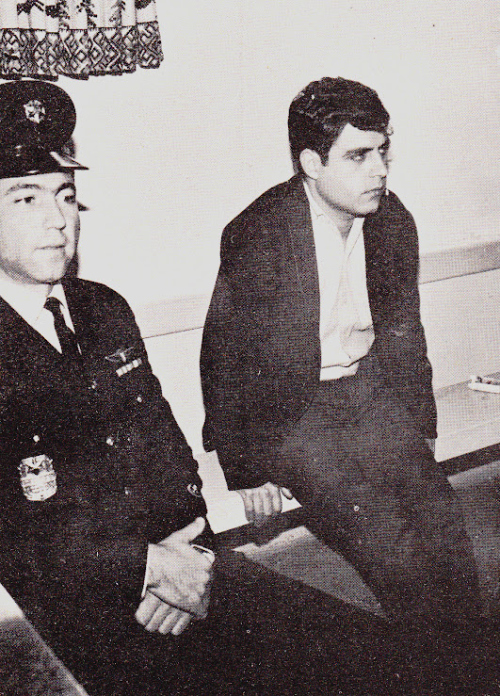 Khalil Toama in the military court, 1969

…so, a situation quite similar to that faced by Samieh Jabbarin after he – also a Palestinian with Israeli citizenship – took part in and organised demonstrations in Israel during last winter’s offensive against Gaza.
Exactly. In Israel, consistent critics – those who truly challenge the state’s Zionist ideology, which dictates that there must be no equal rights for all citizens – face severe repression, especially if they are Palestinian. In this respect, too, they remain second-class citizens, with significantly curtailed rights. My ‘offence’ was being a member of Matzpen, a left-wing anti-Zionist group. Most of us were Jewish. We also worked closely with the Israeli Black Panthers, a political group of Mizrahi Jews. Like us, they opposed the Israeli state because of its racist ideology. Mizrahi Jews – those from Arab countries or Iran – were and still are discriminated against in Israel compared to Jews of European descent. Together with the Black Panthers, we fought against this racism.
Even Jewish citizens of Israel can sometimes face political repression – and it seems to be happening more frequently. For example, during the recent Israeli attack on Gaza, hundreds were arrested, many pre-emptively, simply for organising protests or taking part in non-violent direct action. Among them were Jewish Israelis as well.
Indeed. There have also been cases in the past where radical critics of the occupation were imprisoned – ‘despite’ being Jewish. One example is Michael Warschawski, who was also a member of Matzpen.
So, you left for Frankfurt… Why specifically there?
In Matzpen, some of us were Jews with German roots, and we had connections with German leftists from the SDS [Students for a Democratic Society, one of the principal organisations of the New Left in Germany – Translator]. By the time of the 1967 war and the subsequent occupation, many of them came to see Israel as a colonialist or imperialist oppressor, violently denying the Palestinians their right to self-determination. Before 1967, perceptions in West Germany and elsewhere were quite different: leftists were mostly sympathetic to Israel, which was largely socialist or social-democratic in character – the Israel of the kibbutzim. This changed rapidly and radically after the Six Day War.
Did you ever encounter any antisemitic attitudes among your German comrades at the time?
To begin with our own experience in Israel – Matzpen was an anti-nationalist, internationalist, leftist organisation. Naturally, we rejected everything national and the idea of the state altogether, and we utterly detested Hitler, National Socialism, and everything associated with it. However, we didn’t particularly focus on the Holocaust or the history of Jewish persecution, because these were not central issues in Israeli society until the early 1960s. That only changed with the Eichmann trial. Before then, Israeli discourse was largely silent on the fate of Jews during World War II. The Zionists saw it as a shameful history because, as they put it, the Jews of Europe had “gone like sheep to the slaughter”. This perceived weakness didn’t fit the image of the ‘new man’ that Zionism had created – a strong, defiant figure. Survivors who were old, ill, or visibly scarred by their experiences were often marginalised by Israeli society and treated with little kindness by the state.
As for Germany, I remember meetings with leftist comrades at Club Voltaire in Frankfurt around 1971 or 1972. We discussed the Holocaust, which was a new topic for them. Many admitted they had never had the courage to speak to their parents about it. They were much more sensitive about it than our Jewish comrades. I’m not sure why – whether it was shame for their parents, fear of being labelled antisemites, or perhaps both. In any case, I never encountered antisemitism among the German left at that time.
My political awakening came a little later than yours, in the early 1970s. We young German leftists were politicised mainly by the ‘discovery’ of what had happened just a few years before our birth – in our immediate environment, including our families, schools, and wider society. I am referring, of course, to the reign of National Socialism, its deep entrenchment in almost every aspect of German society, its murderous racism, but also the widespread conformism and lack of resistance that allowed our parents’ or grandparents’ generation to stand by while their neighbours were discriminated against, deported, and ultimately murdered.
As we understood it, the Jews were not the victims per se, not in an absolute sense. We saw Nazism, with all that it entailed, as part of the potential inherent in capitalist society – as Marx, Adorno, and others had, in our view, analysed it – something that could re-emerge. It was clear to us that others could be, and indeed had been, victims as well. In Germany, the workers’ movement was the first to be crushed – its parties, trade unions, associations, and organisations. For us, the logical consequence was constant vigilance against any form of institutionalised inequality, persecution, discrimination, or racism.
In light of all this, I was astonished when, a few years ago, it suddenly became fashionable to accuse the ’68 generation of antisemitism – especially those who had been ‘pro-Palestinian’. I could find nothing in my memory that aligned with this accusation.
A former comrade of mine, a Jewish Israeli, has since adopted a fundamentally pro-American stance. People like him now suspect that even criticism of the US is “antisemitically motivated” – as well as criticism of the banks…
Some ‘leftists’ today argue that criticism of finance capital is (potentially) antisemitic. What an absurd idea! To reach such a conclusion, one would have to harbour antisemitic prejudices in the first place. Like the Nazis, one would have to assume that banks and Jews are structurally connected, that finance capital is ‘in Jewish hands’.
I have, for example, experienced situations where we criticised or questioned Israel as a Jewish state, only to be labelled antisemitic by Germans who called themselves “comrades”. Their counterargument was: “You are negating the right of the Jewish people to a state”. Or when leftists within Fatah referred to Israel as the ‘Zionist entity’, some interpreted this as: “You believe that Jews are incapable of forming a state. That’s antisemitic”. They never responded with “wrong”, “nonsense”, “absurd”, or simply “stupid”. It was always: “antisemitic”. That accusation carries weight in this country.
I also once met someone at ATTAC Germany1 who considered himself a leftist and seriously argued that one should not refer to the occupied Palestinian territories as ‘occupied’ because such terminology was ‘compatible’ with right-wing narratives. The bewildering statements from representatives of Die Linke – declaring ‘solidarity with Israel’ to be Germany’s reason of state, or seriously expressing concern about ‘Israel’s demographic problem’ (the prospect that, at some point, there might be more Palestinians than Jews) – were, at first, incomprehensible to me. Over time, I read up on the subject and came to understand what drives those who have always allowed themselves to be guided from above or by some party line. At some point in recent history, their party (or its predecessors among the long line of dogmatic leftist parties) condemned Israel and supported ‘the Palestinians’ for opportunistic reasons, or out of power-political calculation. Such a crude, blanket positioning is indeed ‘compatible’ with all sorts of things, including antisemitism, which has likely existed in these parts of the left2.
In the 1970s, Israel began spreading this type of propaganda in Germany, but the German left reacted differently than it does today. I remember an interview that the then Israeli ambassador to West Germany, Asher Ben-Nathan, gave to Bild newspaper3. He said something to the effect of: ‘The German left are the legitimate heirs of Hitler’. Shortly afterwards, there was a Palestine-themed week of events at the University of Frankfurt. We – Israeli and German leftists – were there or had helped organise the events. Even back then, the German left was always careful to be ‘balanced’ and had invited the Israeli ambassador in question. The main lecture hall was packed. Danny Cohn-Bendit, with whom I was sharing a flat at the time, called on the ambassador to retract his statement from Bild. Ben-Nathan replied that he had no intention of taking back what he had said. At that, the entire hall erupted in chants: ‘Matzpen! Al Fatah! Matzpen! Al Fatah…’
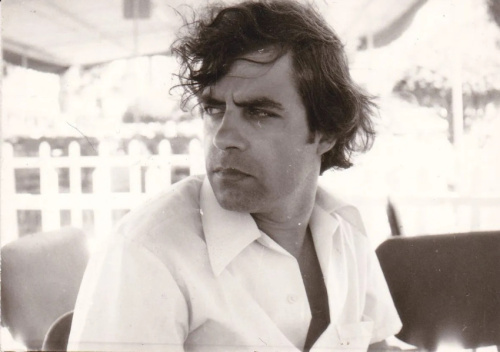 Khalil Toama, 1976

It was remarkable – and almost unimaginable today. They have succeeded in imposing a new definition of antisemitism: recognition or non-recognition of the Jewish state has become the determining criterion. Even advocating self-determination or equal rights for Palestinians – thereby suggesting that the Jewish character of the Israeli state is problematic – now falls under this new definition of antisemitism. Yet this reinterpretation completely misses the reality of actually existing antisemitism. This hollowing out of meaning is only possible because the Germans remain highly susceptible to external pressure. At the same time, they try to deflect from their own realities by fixating on supposed Arab or Muslim antisemitism. Whether such a phenomenon even exists is debatable, as the term describes a fundamentally European phenomenon. Of course, anti-Jewish statements can be found in Arab sources, but given Israel’s policies – carried out by a state that insists on defining itself as Jewish – this is hardly surprising.
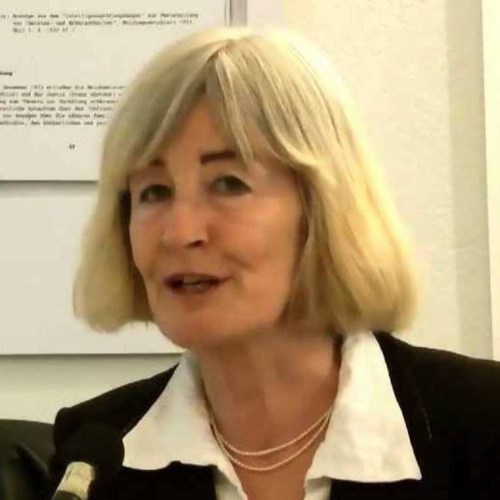 Sophia Deeg. How is it possible that official German policy remains silent, even justifies Israel’s actions
German media, politicians, and institutions bear a share of the responsibility when they uncritically conflate ‘Israeli’ and ‘Jewish’. In my view, they contribute to a new-old form of antisemitism by insisting that Israel is the ‘state of the victims’, equating ‘the victims’ with ‘the Jews’, and granting a state that defines itself as Jewish a special right to commit injustices. If, on top of this, any critical remark – especially from ‘us Germans’ – is deemed problematic or even sanctioned, as in the case of Ludwig Watzal4 and others, it encourages antisemitic fantasies even within the German mainstream. Educated people, readers of reputable newspapers, are not immune – I have seen this time and again recently. At the latest since Israel’s most recent crimes against the population of Gaza, such people have been asking themselves how it is possible that official German policy remains silent, even justifies these actions, while the media strictly adheres to the Israeli narrative. They wonder why even leftists uncritically adopt these views, why they speak of two sides in a conflict where both are ‘partly right and partly wrong’. And they may arrive at a familiar conclusion: there must be some ‘power’ behind it – ‘the Jews’, their financial influence, and so on. These people, who should know better, are, of course, responsible for their own antisemitic thinking, which draws on old stereotypes. But one of the conditions enabling the resurgence of European antisemitism is the irresponsible and uncritical submission of German ‘opinion-makers’ to the language and argumentation dictated by Israel.
I would like to add something about the difference between European antisemitism and anti-Jewish statements in the Arab world: such statements can already be found in the Qur’an, which, for example, warns Muslim rulers not to trust Jews and Christians. On the other hand, Judaism and Christianity are recognised as ‘religions of the book’ and are positively distinguished as such. Both statements must be understood in the historical context of the revelation of the Qur’an. Their meaning changes over time, depending on place, readership, and interpretation. The Qur’an itself establishes this principle of contextual understanding – it is a far more open and less dogmatic text than is often assumed. However, enlightened interpretations are now suppressed in almost all Islamic societies.
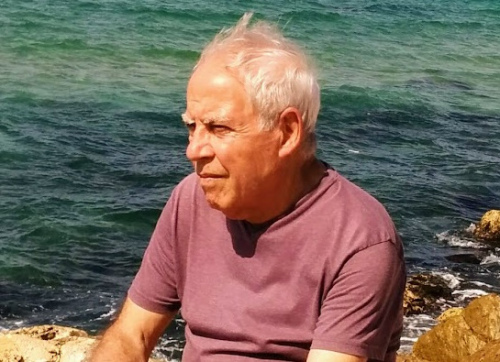 Khalil Toama, Jaffa, 2017

What became of your political activism, which originally catapulted you ‘from a small Galilean village’ to Frankfurt, where you have lived ever since?
The old Matzpen clique still exists; we still meet up occasionally and discuss things, especially when I visit my homeland. At heart, everyone remains deeply involved, though only a few are still visibly active. It was very different back then. When I arrived in Germany, instead of concentrating on learning German and immersing myself in my studies, I joined the revolutionary left – which, in its own way, became a way of learning German. The role of our Matzpen group was very important at the time. We were few, but we were loud. We went from university to university, from teach-in to teach-in. As radical left-wing Israelis – with me as the only Palestinian among them – we made an impression. What struck the Germans was this: if Israelis are saying these things, then criticising Israel cannot be antisemitic. Despite our small numbers, we chose a grand name: Israca. It sounds like Lenin’s Iskra, but in fact, it stood for ‘Israeli Revolutionary Action Committee Abroad’. We translated and distributed key articles from Israeli newspapers about the situation of Palestinians in Israel and the occupied territories, as well as texts from Matzpen. Even as a small group, we had a notable impact, especially because we worked closely with Palestinian organisations. This proved that Palestinians and Israelis, Arabs and Jews, could work together – and that was new.
Today, groups like Anarchists Against the Wall and other radical young Israelis have a similar presence in Germany…
Yes, and I think that is a very positive thing. It is still important to raise this kind of awareness in German society. That is why, for example, I attend Kirchentage5, set up an information stand for the German-Palestinian Society, and take part in debates. I don’t believe we are in a position to establish an effective lobby – we lack the money and the power. But we should maintain a presence, especially in schools and at the grassroots level, and offer alternative information about the Middle East. I want to clarify what this, in my view, is really about: living together with dignity, equality, and equal rights – regardless of whether Jews, Muslims, Christians, or anyone else is in the majority. In Matzpen, we, the Palestinian members, were not token figures, indulged or treated as exceptions. We were equals, with the same rights as everyone else. We were not framed as victims deserving of pity or sympathy.
Translation: Maciej Zurowski
- Translator’s note: attac (Association pour la Taxation des Transactions Financières et pour l’Action Citoyenne) is a global movement founded in 1998 that advocates for social justice, progressive taxation, and greater regulation of financial markets to reduce their influence over political decision-making. ↩
- Translator’s note: However, the one uncontroversially antisemitic act in the history of the German left was carried out by members of a group from Berlin’s anti-authoritarian, ultra-left counterculture. On 9 November 1969, the so-called ‘Tupamaros West-Berlin’ planted a time bomb in the Jewish Community Centre in Berlin during a memorial event for the November Pogroms of 1938, attended by some 250 people. Fortunately, the device failed to detonate. It is difficult to believe that such an action, which the Tupamaros justified as a protest against Zionism, was conceived by a group of self-identified leftists rather than by an agent provocateur. Indeed, as emerged in 2005, the bomb had been provided by a member of the Tupamaros who was also an informant for the German domestic intelligence agency – though all other circumstances remain unresolved. ↩
- Translator’s note: Bild is Germany’s largest tabloid newspaper, known for its sensationalist style, right-wing stance, and often questionable journalistic standards. ↩
- Translator’s note: Ludwig Watzal is a German political scientist and journalist who has written extensively on the Middle East. Due to his critical stance on Israel, he has faced repeated accusations of antisemitism, leading to calls for his dismissal from Germany’s Federal Agency for Civic Education (Bundeszentrale für politische Bildung, BPB). In 2011, the BPB fired him, partly citing his past comments on Israel, but a German court later ruled that the dismissal was unlawful. ↩
- Translator’s note: Kirchentage (‘Church Congresses’) are large Protestant church congresses in Germany, held every two years in different cities. Organised by lay members of the Evangelical Church in Germany (EKD), they feature worship, discussions, and debates on religious, social, and political issues. ↩