

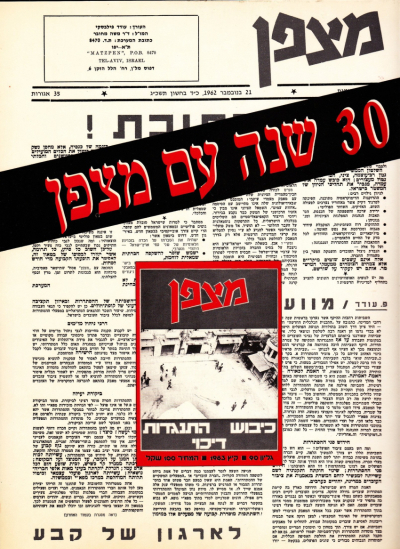
 Thirty Years with Matzpen: The first issue in the background (21.11.1961), the last one (summer 1983) in the center, saying – Occupation, Resistance, Oppression
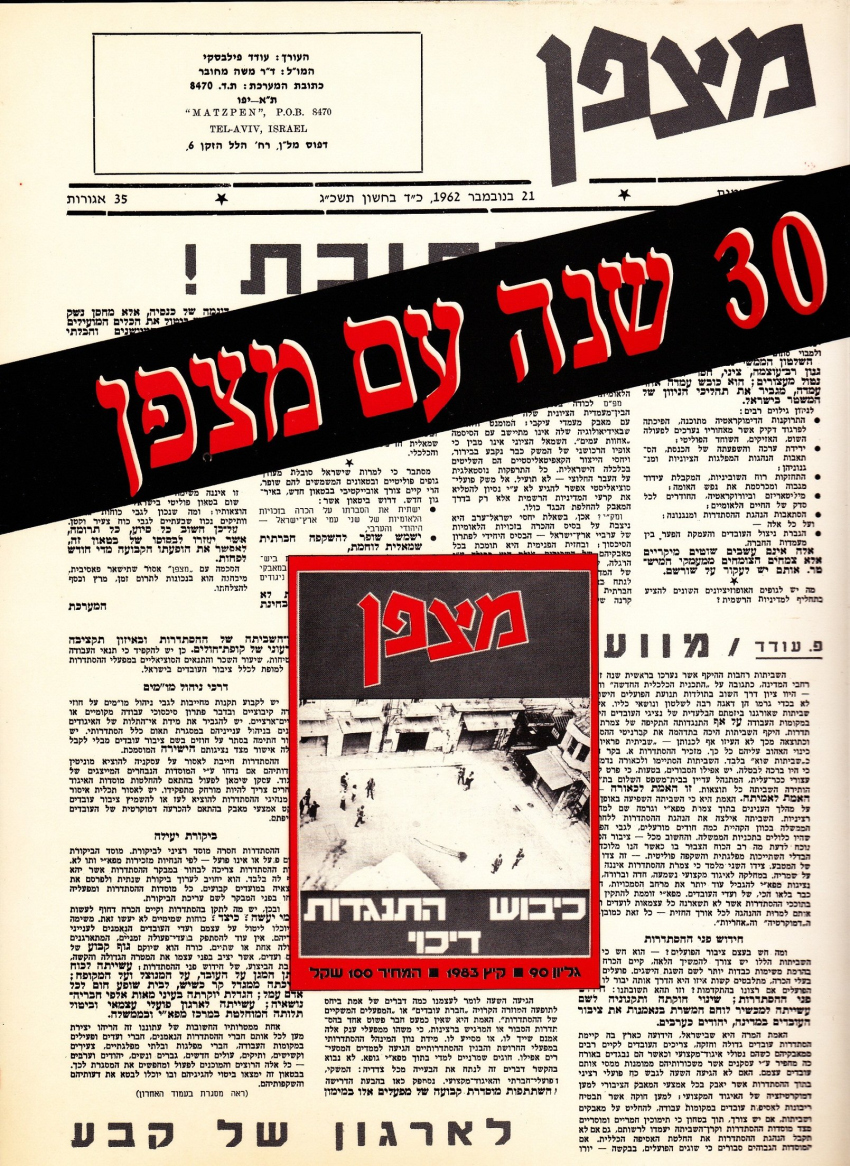
There is apparently nothing new in this booklet: It is intended to mark the 30th anniversary of the appearance of the first issue of Matzpen (Compass), and it contains a summary of every article, news item, or document published in each of the 90 issues. But it has merit, beyond nostalgia or being an aid for those interested. An overview of the pages of the booklet reveals the range of topics that have occupied the members of The Socialist Organization in Israel – Matzpen, and the changes in emphasis over the years.
Alongside the positions that have characterised Matzpen, the organization and the journal, there stand out in the booklet the constant readiness to subject everything to criticism: Zionism the the Histadrut (the zionist trade union federation); capitalism and the bureaucratic oppressive regimes that purported to be “socialist”; the reactionary Arab regimes and those called “progressive”; the movements for national liberation, the Palestinian movement included, and the Communist parties; religion (all religion, especially Jewish and Muslim religions) and the secular people who enable religious coercion; the (Israeli) occupation and the motives of many of its opponents; and yes, even the basic principles of Matzpen.
And the open discussion: the arguments that took place over the years – among members of Matzpen, and between them and other people on the left – were not hidden in documents for limited internal consumption, but found expression on the pages of Matzpen. Undelying this openness is the perception that there is not only one right way to socialism, and certainly no person or group with the only correct Torah who must therefore be the ones to lead the struggle. Matzpen sought to clarify, to itself and to others, what is not socialism, what cannot be the way to socialism, and at the same time what are the basic conditions without which socialism cannot be, without which a society cannot be regarded as socialist.
This fundamental conception also prescribed a democratic organizational structure, and an open editorial policy. It wasn’t easy. Matzpen experienced three splits, and in all three, those who left the organization felt that they had the right key to the door that would lead to the organization’s growth, to promote its goals and to increase its influence. This key was a tougher organizational structure, with an internal hierarchy, known as “democratic centralism”. Moreover: the three groups saw fit to narrow the confines of the organization, and to commit it to one, and only one, school of socialism: Marxism-Leninism, each group according to its own interpretation of the term.
The members of the three seceding groups also refused to recognize that in the Soviet Union and its satelites a new regime of oppression was established, which is no less an enemy of socialism than the capitalist regimes. They put themselves in a global “anti-imperialist” camp that included, notwithstanding criticism, bureaucratic oppressive regimes and Communist parties.
These were expressions of a turn to the right from the traditional positions of Matzpen. Beyond them, these groups were willing to move further away from the basic positions of Matzpen, with the aim of appealing to various movements and sections of the population: workers, Mizrahim, Palestinian nationalists. Sometimes it was due to a sincere belief that social or national struggles may in themselves clarify to the participants the contradictions of the existing regime, and bring them up on the way to socialism.
These tendencies also found expression in the pages of “Matzpen”, certainly as long as their carriers belonged to the organization. But arguing with these comrades also had positive effect: it helped to sharpen and clarify positions. This debate also helped the organization from its inception to analyze the process that eroded the achievements of the October Revolution: The transfer of power from the Soviets (the Councils of workers, peasants and soldiers) to the Central Committee of the Communist Party, the outlawing of all other workers’ movements, parties and organizations, the suppression of fundamental democratic freedoms, from freedom of expression and organization to the right to independent trade unions. And all this happened, long before Stalin took over the party, at the initiative of Lenin and Trotsky, and with their full backing.
None of the three seceding groups reached achievements that would prove that their path was more correct. Two of them, “Maavak” (Struggle) and “Avant-garde”, disintegrated years ago. The third, the Revolutionary Communist League, whose members tried to turn Matzpen into a section of the Trotskyist Fourth International, continued to bear the name Matzpen even after the split, and only added to it the title “Marxist”.
This booklet covers only the journal that continued to be issued by the Socialist Organization in Israel – Matzpen. The founding members of Matzpen did not leave in any of these splits. The editor of Matzpen, Oded Pilavsky, and its publisher, Moshe Machover, remained the editor and publisher from issue 1 to 90.
The journal Matzpen was produced during all of its years by voluntary work. The writing, the editing, the graphic design, the preparation for print, the assembling of the printed pages, and the selling of the paper were all voluntary. Not only had none of the members got paid, but the deficits, when they occured, were covered with members’ subs and donations. In the first few years, the circulation of the newspaper was small, just a few hundred. After 1967, the circulation gradually increased, and by the 70s, 2,000 copies of each issue had been printed, most of them sold (about 1,500 of them in Arab communities). Distribution reached its peak in issue 77 [following the first Land Day]: The 2,000 issues printed were sold out within two weeks, as were the additional 1,500 issues printed. The last issue, No. 90, was printed in 500 copies, in Hebrew only. All sold out.
Thirty years have gone by, and it seems that Matzpen has returned to its starting point and even retreated from it: the number of members dwindled, the mobilization required to publish the newspaper, and especially its distribution, eroded the enthusiasm, and the publication of the newspaper ceased in the summer of 1983. Since then, the organization has issued only a few public statements and booklets.
The theoretical contribution and correct positions of Matzpen did not lead to a revolutionary breakthrough. The proposition that the Palestinian problem (or rather Zionism) is at the heart of the Israeli-Arab conflict; The call for the transformation of the Histadrut into an authentic trade union and for its separation from its health fund and its Industrial and agricultural corporations; The criticism of the regime in the Soviet Union (and China); The support for the right to self-determination of the Kurds and the South Sudanese (and of the Israelis); The close monitoring of the development of the Polish opposition from a tiny leftist nucleus to the Solidarity workers’ movement of millions; The unqualified resistance to the Israeli 1967 occupation from its first day and the recognition of the right, and duty, of the Palestinians to fight against it; The recognition of the PLO as a representative of the Palestinians and the first attempts to open discussions – initially with the Palestinian left and then with the PLO representatives themselves; All of these, and more, did not lead to a significant increase of the organization.
Some demands that Matzpen first raised, being a small, marginal and outcast minority, are accepted today by relatively large parts of Israeli society. Still, Matzpen remains a small, marginal minority, perhaps a little less outcast (perhaps after it was proved to be no great danger to the straitjacket of the Zionist consensus). So where did we go wrong? This booklet cannot provide the answer to that.
We were wrong, of course we were wrong, but these were mistakes in assessment, not of principle. We believed that Cuba, led by Castro, was going to set an example of a different kind of socialism, and have been proved wrong. We thought that the Arabs’ aspirations for a political union would be the basis for building a revolutionary socialist force, which would succeed in realizing these aspirations on the ruins of the existing Arab regimes, which insisted on maintaining the divisions; And the only Arab union that has succeeded so far was the unification of Yemen, after the defeat and disintegration of the socialist forces in the south.
We believed that the Palestinian left, and especially the Democratic Front for the Liberation of Palestine, was standfast behind its stated positions, and that the gap between us was narrowing, only to discover that it was mainly a recitation of revolutionary texts, which were fashionable at the time. We did not believe that the occupation would last this long, and therefore we were too late to insist on the need to demand equal rights for the residents of the occupied territories. We thought that following the first Land Day, a mass Palestinian struggle would develop for Israel to become a democratic state for all its residents, and that did not happen.
And there were probably other misjudgements. But it seems that even if we had not made a single mistake, Matzpen would not have achieved much more. And not just because of our uncompromising anti-Zionist position. Thirty years ago we did not know, or perhaps could not know, how destructive and paralyzing was the influence of the regime of bureaucratic oppression in the Soviet Union. We knew that it was an enemy of the socialist revolution, but we hoped that a socialist revolution would bring it down. The Prague Spring and the 1968 student uprising in France, the rise of the new left, the revival of the feminist movement, the black minority’s struggle in the United States for equal rights, and the rise of national liberation struggles in the Third World helped to keep the illusion alive.
It is now clear that years will pass (how many?) until humanity is liberated from hostility to socialism and its red flag, due to its identification with the crimes of the Stalinist bureaucracy. What is also clear is that the fall of “Communism” does not purge capitalism of the stains of exploitation and oppression that constitute an integral part of it. The struggles against capitalism, or against phenomena it engenders and perpetuates — and such struggles are waged almost all the time, almost everywhere — show that the struggle for socialism does not die, even if it is not their stated goal.
For socialism, despite the bad example of the regimes that bore its name in vain, is still the alternative to a world in which phenomena of class exploitation, racism, national oppression, sexual discrimination, excessive abundance alongside scarcity and hunger are prevalent. As long as people continue to fight for a better life, the prospect of socialism materializing will continue to glimmer. And even if it does not come soon, it is still a goal worth striving for and struggling for, if only to protect and improve the quality of life in the present.
The purpose of Matzpen, as stated in the first paragraph of our Basic Principles, is to act “against any exploitation and oppression of one person by another and for a global socialist revolution that will abolish all existing socio-political regimes (which are based on exploitation and oppression) and will establish a classless affluent society of free persons, managing collectively and consciously the process of their social life, and creating and appropriating social wealth in common”.
This is the flag that we continue to hoist, and we see no reason to fold it.
The Socialist Organization in Israel — Matzpen
September 1992