

 The pamphlet’s front page: Arabs, Jews and Racists.
Cartoon’s caption: “Who is the Racist?”

Introduction
On February 2nd, 1979, the International Convention on the Elimination of All Forms of Racial Discrimination came into force in the State of Israel. This Convention defines the term “racial discrimination” as follows: “Any distinction, exclusion, restriction or preference based on race, colour, descent, or national or ethnic origin which has the purpose or effect of nullifying or impairing the recognition, enjoyment or exercise, on an equal footing, of human rights and fundamental freedoms in the political, economic, social, cultural or any other field of public life.”
Within the framework of this Convention, the State of Israel pledges itself “to engage in no act or practice of racial discrimination against persons, groups of persons or institutions and to ensure that all public authorities and public institutions, national and local, shall act in conformity with this obligation.”
Likewise, the State of Israel, like all other nations that have ratified the Convention, accepts the obligation “not to sponsor, defend or support racial discrimination by any persons or organizations.” This, and more. The Convention also declares: “States Parties condemn all propaganda and organizations based on ideas or theories of the superiority of one race or group of persons of one colour or ethnic origin, or which attempt to justify or promote racial hatred and discrimination in any form.” As a ratifying State Party, Israel also accepts the responsibility “to adopt immediate and positive measures designed to eradicate all incitement to, or acts of, such discrimination.” Among other things, Israel obligates itself “to declare an offence punishable by law all dissemination of ideas based on racial superiority or hatred, incitement to racial discrimination, as well as acts of violence or incitement to such acts against any race or group of persons of another colour or ethnic origin.”
The International Convention on the Elimination of All Forms of Racial Discrimination obligates the State of Israel to “declare illegal and prohibit organizations, and also organized and all other propaganda activities, which promote and incite racial discrimination.” In addition, as a State Party to the Convention, Israel accepts the obligation to “recognize participation in such organizations or activities as an offence punishable by law.”

 The Arabs want to rule the world by means of their oil.
The Jews want to rule the world by means of their money.


Who is the racist?
What Is Racial Discrimination?
Whenever a governmental, public or private institution discriminates against individuals because of their origin – that is racial discrimination. Such discrimination is particularly serious when it is practiced by government institutions and agencies which are meant to represent and serve all citizens in equal measure; for example, the preferential treatment given to individuals of a specific origin in respect to the right to acquire citizenship, or preventing others from freely participating in the political life of the country. Other examples are discrimination in connection with everything associated with the right to migrate to and from the country, and the right to freely choose one’s place of residence, profession and place of work; the right to acquire an education; the right to free movement throughout the country; and, in extreme instances, even the right to life itself. Whenever such rights are granted to certain individuals and – on the basis of differing origin – denied to others: that is racial discrimination.
What Is Racial Separation (apartheid)?
Whenever individuals of differing origin are prevented – either by legal means or by bringing other pressures to bear – from living together, working together or spending their leisure time together, having sexual relations and marrying – that is racial separation, apartheid.
How Is Racism Manifested within the Area of Social Relations between One Person and the Next?
Whenever individuals are prevented from associating with others solely on account of their origin; whenever parents educate their children to relate to and behave toward certain persons in a particular way on the basis of their origin; whenever a negative (or positive) trait is ascribed to any human group whatsoever solely on account of their origin; whenever people tell jokes which make fun of a certain group of individuals due to their origin – all these are manifestations of racism in the interpersonal sphere, more precisely distinguished as racialism.
Is there a Connection between Race and Racism?
There are those who contend that discrimination practiced by Jews against Arabs cannot be considered a manifestation of racism due to the circumstance that both peoples belong to the same “race”: the Semitic race. However, the modern term “racism” is not concerned with the classification of human beings into various races (superior and inferior), but rather with the examination of all forms of discrimination against human beings on account of their origin, whether such discrimination is based on “racial” origin, or because of national, tribal, communal, religious or sexual origin1 Israel Lands Administration, which has to approve the deal, is made up of 50% members of the JNF, and they protect their rights. The truth of the matter is that the Lands Administration, when it was entrusted with administering the lands of the JNF, also adopted these basic principles’.” (Extract from an article by Orit Shochat, “And a man shall not cultivate a tomato…”, Haaretz Weekly Supplement, 27 September 1985.)].
Is Racial Discrimination Practiced in Israel?
Yes, and this despite the pretension of the state to be democratic. There is, for example, a law (the Law of Return) which recognizes the right of individuals of a particular origin (Jewish) to become automatically citizens of the state, but which denies this right to people of another origin, even if they were born here and this is their native land (e.g., the Palestinian refugees). There also is, for example, a government agency (Israel Lands Administration) which controls most of the land in the state, and which administers the regulations of the Jewish National Fund in respect to this land. According to these regulations, only Jews have the right to live on these lands, to lease them or to cultivate them and enjoy the fruits they yield. Another recent such example: within the framework of the withdrawal from Sinai, the government – basing its actions on laws passed by the Knesset – acted in a discriminatory fashion toward two different communities: the settlers in Sinai (Jews) were granted astronomical compensation for property which they had received for nothing (1) and which had been in their possession for ten years at the most; the Negev Bedouins (Arabs), however, who were removed from their lands and relocated for the sake of the Israeli military, received minimal compensation for property which had belonged to them for generations.
Does the State of Israel also Practice a Policy of Racial Separation?
Yes. Within the framework of Israeli law, members of different religious faiths are denied the possibility to intermarry. The “national origin” of each and every Israeli citizen is listed in their official identity card. Up until 1966, Arab citizens of Israel lived under a system of military rule, which limited their freedom of movement and in this way controlled their sources of income – and only their sources of income. According to the rules and regulations of the Jewish National Fund – which have the status of state law in Israel – an Arab cannot become a member of a kibbutz or moshav, and there are locations in which the right to purchase apartments is limited solely to Jews: for example, in the development town of Carmiel in the Galilee, or in the Jewish Quarter within the Old City in Jerusalem2.
What Additional Types of Racism are Endemic in Israel?
The fact is that members of a people which itself was in the past the victim of racial discrimination are not immune from racialist behavior toward others. This is what Jewish history in this century teaches us. Nor are the Palestinians immune to manifestations of racism; thus, there is a problem among Arabs of racialist prejudice against Jews, which finds its expression in the feeling that “all Jews are the same”, and that they are apparently all guilty of acts of oppression and discrimination against the Palestinians. Such racialism can manifest itself, for example, in attacks directed at Jews solely because they are Jews, or in the dissemination of notions regarding a desirable solution, within whose framework Jews would be relegated to second-class citizens. To a considerable extent, conceptions like these are a reaction to the racial discrimination from which Palestinians have suffered for decades, though this, of course, is no reason to excuse or tolerate such ideas.
There exists, in Israel, also the problem of racism and racial discrimination based on communal origin. This, by the way, is not found only within Jewish society (Ashkenazim vs. Oriental Jews), but also in Arab society as well (whites as opposed to blacks, Moslems contrasted with Christians, permanent residents over Bedouins and gypsies). It is worth pointing out that racialism on the part of Jews of European and American background toward Jews originating from Arab and Islamic countries is, in actual fact, an extension of Jewish racism toward Arabs: because these Oriental Jews were brought up in the ways of Arab culture, and are also similar to Arabs in their physical appearance, the racism which was endemic against Arabs was also extended to include them as well. In recent years, there has also been a burgeoning “anti-Ashkenazi” racialism; this, in essence, is an exaggerated response on the part of those oppressed to the discrimination which they themselves have suffered from.
There are also other types of racism which generally are not regarded in the public eye as being manifestations of racial discrimination and which, for this reason, enjoy much more legitimacy. What is involved here are certain forms of discrimination directed against individuals because of the circumstances of their birth, or on account of biological factors for which they are not responsible. One such example is the discrimination against women (vis-a-vis men) as it is anchored in numerous laws, in particular as far as women’s equal rights are concerned in marriage and divorce proceedings. In this area, there is a widespread phenomenon of anti-female racism which is imbued with certain ideological dimensions, and which holds that all women are inferior to men by definition; that women enjoy being treated aggressively, and even violently; that women are suitable only for specific occupations, etc. In a like manner, there are components of racism in the discrimination directed toward individuals on account of their physical appearance, disabilities, and the like. In the last analysis, all these constitute expressions of racism, in that they are not dependent on the abilities of the person oppressed, his/her character or ideas, but rather only on factors not under the person’s control.
The Answer to Racial Discrimination – Equality of Rights!
Full equality of rights, in actual concrete practice – that is the solution to struggle for in every country where racial discrimination is practiced toward any group of its citizens. This involves an uncompromising struggle to eliminate all forms of apartheid and racial discrimination, a struggle for full equality of rights for all individuals, irrespective of racial, communal or national origin, or religious or cultural affiliation.
Can Legislation also Provide an Answer to Racialism Manifested in the Interpersonal Sphere?
Any state which supports full equality of rights should also include in its laws a prohibition against all forms of racial discrimination. However, the state is not able or authorized to interfere in the thoughts of its citizenry, or the manner in which they have chosen to live their private lives. The state is obliged to make it possible for individuals of differing origin to intermarry, and the state is forbidden to discriminate against such couples in any way. The struggle to change the preconceived ideas and racial prejudices of individuals must be fought within the realm of education and culture; it should not be a struggle conducted by the government using laws, penalties and prohibitions. It is impossible to force a person to marry or develop social relations with persons of a different origin. But it is necessary to foster a public atmosphere in which such social relations are not regarded as a disgrace, but rather are fully accepted as something normal and natural3.

 PALESTINE RESTAURANT
The tables: Reserved for Soviet Jews; Reserved for South African Jews; Reserved for USA Jews.

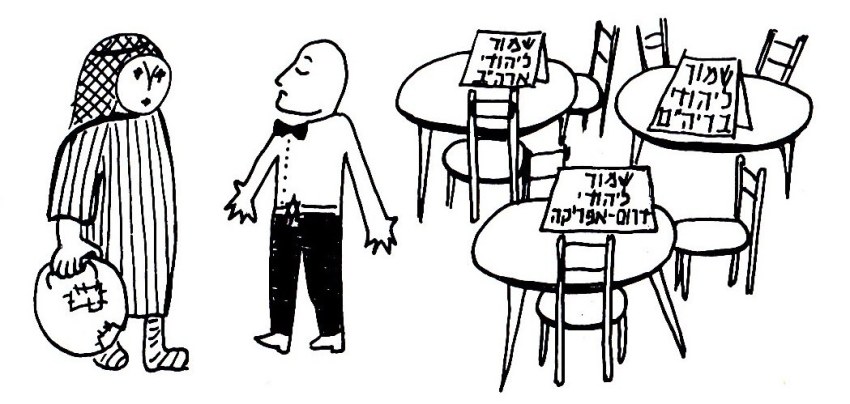
The waiter: “Sorry! All the seats are reserved…“
The United Nations Assembly Concluded that Zionism is a Form of Racism. Is Zionism in fact Racist?
The basic assumption of Zionism holds that Jews and non-Jews cannot live together in peace over time, and that these two groups differ in a natural, essential and unchanging manner. This, by the way, is also the fundamental assumption underlying anti-Semitism. There is, though, a difference between them: Zionism regards “Jewish uniqueness” as something positive, a “chosen people”, while anti-Semitism views the Jews as inferior. Even the solution advanced by the Zionist movement is similar to that advanced by many anti-Semites: separation between the two groups by means of migration of Jews, expatriation to another country, along with opposition to so-called “mixed marriages”. An additional racist principle which the Zionist movement adheres to is that Israel is a Jewish state, and that it belongs not only to the Jews living in its borders, but to all Jews throughout the world. This principle makes it impossible for any citizen of Israel who is not a Jew to view the state as his/her own.
The Zionist idea is also based on the assumption that Arabs who are inhabitants of the country constitute a group which does not have the right to determine its own fate and the political framework in which it wishes to live. Even those who came to recognize that the Arab position in the conflict is based on just claims decided that, in any event, the claim of “Jewish justice” carries more weight and importance than “Arab justice.”
What is the Special Feature of Kahane’s Movement?
Kahane didn’t invent Jewish racism. His political program is composed of a collection of points which have all constituted in the past – and even, in part, still make up – some portion of the political program or ideology of various Zionist movements or Jewish religious currents. What is unique and special about Kahane is that he unites different components of racism and focusses them in one single movement – by emphasizing that all these points are bound together by the common factor of Jewish religious tradition, Jewish Halacha. The following are the principles of Kahane’s “teaching”, of his torah:
- Expulsion of the Arabs. In the late 1930s, there were deliberations within the Jewish Labour movement on a proposal to carry out a population “exchange” with neighboring countries or, more precisely, the “transfer” of Arab inhabitants of Palestine to neighboring countries. In the years 1948-1949, during the course of the war, this policy was carried out in actual practice and made a reality within the framework of Plan Dalet of the Haganah This plan presented the armed forces with the following combat objective: to gain control of all territory set aside for the Jewish state in the U.N. Palestine partition resolution. Among the actions recommended by that plan: “Extermination of villages – the burning, blowing up and mining of the ruins.” The I.Z.L. (or so-called Irgun, an underground organization) also operated according to this model in the atrocities it perpetrated in the village of Deir Yasin and other places. The underground organization Lehi (otherwise known as the Stern Gang) supported a similar solution. In his manifesto The Principles of Revival, Avraham Stern, the first commander of Lehi, wrote: “Judgment of the foreigners – solution to the problem of the aliens by means of an exchange of the population4.” Most of those who had reservations about or were opposed to a mass expulsion of Arabs praised the fait accompli after it became a reality. From then on down to the present day, official Israeli policy has held that the refugees must not be repatriated.
- Opposition to Social Relations between Jews and Arabs, in particular opposition to sexual relations between Jewish women and Arab men. Jewish tradition views a Jewish man or woman who marries a non-Jew as a person lost to the Jewish people. Kahane represents himself as someone for whom this is the sole motive for being involved in the issue; as a matter of fact, however, Kahane is attempting to inflame the feeling of male “honor” and superiority of the Israeli who refuses to accept the fact that a Jewish woman could actually choose an “inferior Arab male”. Underlying this unwillingness to accept the existence of social relations between Jews and Arabs there is also a feeling of inferiority, and the fear that in such a meeting between Jew and non-Jew, the latter may indeed influence the former. However, the prevention of “mixed marriages” remains a declared and essential goal not only of Meir Kahane, but of the world Zionist movement, and the representatives of this movement deal with this issue as a central concern in their work in Jewish communities outside Israel. The desire to be separated from all other peoples in order to establish an exclusive Jewish state remains a basic Zionist concept – its essential nature is self-segregation, separation and apartness, apartheid. This accounts for the thrust to establish settlements made up solely of Jews, such as kibbutzim and moshavim. And this accounts for the desire to establish separate Jewish urban centers, even in localities where a developed Arab urban settlement was already in existence (Tel Aviv, Upper Nazareth and others). It is important to recall that Kahane, in respect to the matter of social relations, has indeed copied the racial laws of the Nazis, and has recommended punishing by law any persons engaging in “mixed” sexual relations. In so doing, he has moved from a more customary type of ideological-racist opposition to “mixed marriages” to the clear and unmistakable Nazi position of forced racial separation anchored in law.
- A State Governed by Jewish Halacha. The wish to impose Jewish traditional religious (Halachic) laws on the state and to do away with any and all democratic components which are nonetheless still present in Israel is a desire shared by all the [Jewish] religious parties. They differ from each other only in the tactics used to attain the objective. Kahane, however, intensifies and sharpens the racist conceptions within Jewish religion, and attempts to put these elements – and only these – front and center. He builds on deep foundations in Jewish religious consciousness, such as the notion of the “chosen people”, the “kingdom of priests and the holy people”, a “people that shall dwell alone, and shall not be reckoned among the nations” (Num. 23:9), “Pour out your wrath upon the nations” (Jer. 10:25), and so forth. In short, he bases his position on the same primitive, tribalistic and racist principles which are characteristic of the greater part of all Jewish religious currents in Israel. In contradistinction to them, however, Kahane publicly proclaims these things and presents them as the pith and essence of the Jewish religion5.
- Preaching against the Kibbutzim, against the “Ashkenazim“. Kahane cynically exploits genuine feelings of deprivation and discrimination among Oriental Jews (they themselves being victims of racism) in order to direct their anger against the Arabs and their “friends and sympathizers”. For this purpose, he presents himself as someone who articulates Oriental, Jewish-Sephardic bitterness against the “Ashkenazi”, “leftist”, kibbutz-based establishment, but he is careful to channel their feelings of hatred toward the so-called “real enemy” – the Arabs. Kahane furnishes Oriental Jews in Israel with a racist answer to the problem of racial discrimination.
- Proposal of a Solution to the Problem of Unemployment. Kahane yokes together his hatred of Arabs and his desire to be conceived as someone who represents the oppressed Jews; in this way, his hope is to capture the historical position of the left. His proposed “solution” to unemployment in Israel is to fire Arab workers and hire unemployed Jewish workers in their place. Such a policy, in fact, was practiced in the Zionist movement almost from its beginnings, and is basically a continuation of the policy of “Hebrew labor.”
All these points sound familiar to many, and – for that very reason – even “legitimate”. The fusing of all these components within the platform of one single political party creates a situation where Kahane’s words fall upon attentive ears. It is not for nothing that Kahane repeatedly declares: “I say what all of you are thinking.” There are many who would say that although they don’t agree with everything Kahane is saying, they do agree with a portion of his proposals. Kahane is the only one in the Zionist movement ready to advance a final and unequivocal solution, “once and for all time”, for the problem which everyone in Israel is troubling with: the nature of relations between Arabs and Jews. Kahane says: “Arabs out!” To many it appears that this might be a quick and complete answer to the question.
In the eyes of many religious Zionists, Kahane is conceived as someone who goes “all the way” with Jewish religious ideology. Whereas in the eyes of many secular Zionists, he is seen as someone who takes Zionist ideology “all the way”. That is to say, he is both the true Jew and the true Zionist. The amalgam of the components of his “teaching”, however, can lead only to one conclusion: Kahane is the true Jewish Nazi.
If so, Then What is Kahanism?
“Kahanism” is the name of the Jewish Nazi movement. Now, why isn’t this abomination called by its real name? Because there are many in Israel who would like to conceal the fact that there is a Nazi movement active in the country, and whose ideas enjoy relatively broad popular support. By making use of the term “Kahanism”, it becomes possible for political movements which are themselves contaminated by racism to project themselves and be seen as parties struggling against racism, while fighting – if at best – only against the movement of Kahane. Thus, the struggle against “Kahanism” is not a struggle against racism – rather, it is only against the most radical and vociferous expression thereof.
A person who truly wishes to struggle against racism cannot be content simply with engaging in a political struggle against Kahane and his movement. This is because the fight against racism is a struggle against racist conceptions and passions that have been taking deeper root in the Israeli public from year to year. In fact, Kahane has let those passions free, and he openly and unabashedly attributes them to his own influence. Parallel to all this, and removed from the spotlight of notoriety, racial discrimination is being regularly practiced by individuals, agencies and institutions belonging to every shade and hue of the spectrum of the Zionist movement – even by those who have placed themselves at the very head of the struggle against Kahane’s movement.
As a concomitant phenomenon, Kahane’s political success has awakened intense anti-racist feelings and sentiments in a great many Israelis, and that has made it possible for the struggle against racism to emerge as a factor in the public arena. If until quite recently it was customary practice to deny the presence in Israel of racism as a serious social problem, there is now no doubt that this is in fact the case. The struggle against the ideas being propagated by Kahane and his movement serves to render it possible for individuals whose own thinking was contaminated by racial prejudice to clarify to themselves what racism really is – in order to know how to combat it effectively. And in Israel – this is abundantly clear – the struggle against racism must include a penetrating critique of both Zionist ideology and the racist principles and foundations of the Jewish religion.
 Religious Conversion Exam: Who is a Jew?
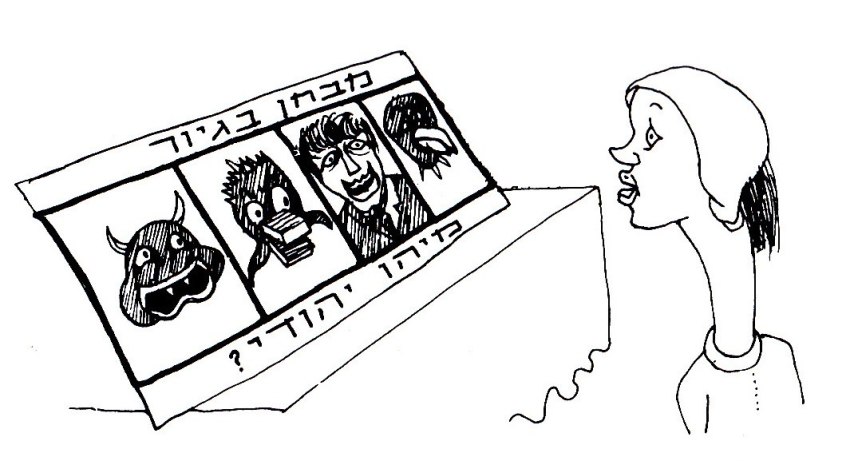
Is Racism at the Root of the Arab-Israeli Dispute?
Public discussion in Israel has recently focused on the danger of the new manifestations of racism – as if they were the sole or fundamental problem whose solution must be fervently sought. However, the Palestinian problem did not come about because of racism, even though racism constitutes a part of it6. As strange as it may sound, it would be indeed possible to create a situation in which racial discrimination in Israel would be eliminated, but in which the Palestinians would nonetheless continue to suffer from oppression.
Let us try to imagine the following scenario: the opponents of racism have succeeded in their struggle in Israel. As a result, all laws, regulations and practices discriminating between Jews and non-Jews have been abolished7; the religion or nationality of the bearer is no longer registered in one’s official I.D; the State of Israel has recognized the rights of all Palestinian refugees to return to their land (or be given compensation) and to take up residence there wherever they choose. Full equality of rights now exists in actual practice for all citizens – and is not conditional on their respective origin. All this holds true for Israel within the “Green Line” (pre-1967 borders). But in terms of this same fictive scenario, this non-racist Israel continues to hold on to the Occupied Territories and their Palestinian inhabitants still live under military rule. Within Israel, the Jewish national institutions still continue to exist – but Arab citizens of the state are denied the opportunity to organize as a national community and to freely set up their own parallel institutions. The Arabic language continues to be recognized as an official language of the state, but even now has not been accorded a status of full equality.
In this imaginative situation, the Arab citizen who is prepared to “assimilate” – in respect to language and culture – into the Israeli-Jewish majority will be able to do so and to rise to any role without discrimination on account of his/her origin. However, Arabs as a collective, a group, will continue to suffer from oppression. In this theoretical situation, there would be no racial discrimination against the Arab as an individual, but discrimination against Arabs as a community would continue. This type of discrimination is termed national oppression.
What is National Oppression?
National oppression exists when one nation forces its rule on another national collective, and denies it the freedom to exist as a national entity, or denies it any one of the collective rights of free national existence.
Whenever any national formation/community is denied the freedom to use its language or to develop its culture – and it is forced to undergo linguistic and cultural assimilation – that constitutes national oppression (such as in the case of the oppression of the Kurds by the Turkish authorities).
Whenever – in a country where several national groupings/communities live – one of these aspires to autonomy within the multinational framework and is denied that right – that denial constitutes national oppression (example: the oppression of the Kurds by the Iranian government).
Whenever a people aspires to establish a sovereign state in the territories it inhabits (and in which it constitutes a substantial majority of the population), and that right is denied to it through outside interference by another people – that constitutes national oppression (example: the oppression of the Palestinians by the Israeli government).
How is National Oppression Manifested within the State of Israel?
Within Israel’s borders, the Arab-Palestinian minority has not been granted recognition as a national minority. When Arab citizens attempted to set up a national political movement (Al-Ard), it was declared illegal in the 1960s. When, in the early 1980’s, Arabs tried to establish their own representative institution (Congress of the Arab Masses), that body was also deemed illegal. When Arab citizens requested permission to establish a university in the Galilee with Arabic as the language of instruction, their proposal was rejected by the Council for Higher Education. Academic institutions go to great pains not to grant recognition to Arab students’ committees as bodies which represent the Arab students 8. It is officially prohibited in Israel to display the national Palestinian flag, and popular singers are penalized for performing national songs, even at private parties such as weddings. Any organized attempt to represent the Arabs as a community, beyond the municipal framework, is prohibited by the state authorities.
The Answer to National Oppression – Recognition of the Right to Self-Determination!
National oppression awakens within the oppressed minority aspirations for political separation and detachment from the oppressing majority in order to gain liberation from their rule. However, one can also struggle against manifestations of national oppression without encouraging such aspirations for separation.
In point of fact, national oppression is the denial of the right of a national community to self-determination. The right to self-determination (including the right to set up an independent state) is the most fundamental and basic national right, and all other national rights are either contained within it or flow from it. The meaning of the right to self-determination is that a national minority has the right to decide whether it wishes to remain within the existing state-political framework, or to separate from it. If the minority should decide to remain within the existing framework, it has the right to establish governmental autonomy or national-cultural autonomy within that framework, or to fully integrate as individuals in the social life of the state – on the condition that they are guaranteed the right to decide otherwise at some point in the future.
There is no more powerful motive for separation than the presence of national oppression. For this reason, recognition of the right to self-determination is not simply a matter of basic justice, but is also a kind of “insurance policy” for the majority: it is the best means to convince the minority to preserve the common, shared framework.
A good example of this was given by the Basque people in Spain. In 1936, when the Civil War erupted in Spain, the majority of the Basque people leaned toward the right in religious and social questions, and their views brought them close to those of the Fascist rebels under the leadership of Franco. But the Republican government in Spain recognized the right of the Basque people to self-determination, and within its framework the Basques set up autonomous rule. Franco, on the other hand, refused to recognize the national rights of the Basques. The Basques chose therefore to stand by the Republic, notwithstanding the great gap that existed between them and the Republican government in regard to many social questions. The Basques fought on the side of the Republic in its defense – and against Franco – right to the bitter end. I.e., it was the recognition of the right of the Basques to self-determination which gained the Republic their support in its life-and-death struggle.
An additional example can be taken from the Canadian experience. There the French-speaking citizens of Quebec engaged in a struggle for independence from the rest of English-speaking Canada. The inhabitants of Quebec protested against their discrimination at the hands of the Canadian authorities, discrimination which awakened their aspirations for independence. But when representatives of the nationalist political party, the Parti Québécois, gained a majority of legislative seats and formed the provincial government – and it was in their power to create a sovereign state of Quebec – they chose not to do so. Within a few years, they succeeded in doing away with many of the oppressive laws which they had suffered from. At the present time, the majority of Quebec’s citizens support remaining within the Canadian federation. The fact that it is in their power to decide at any time on the creation of an independent state has influenced Quebec’s citizens to exhaust all other possibilities for improving their situation before taking the drastic step of secession. There is no doubt that if the federal government in Canada did not recognize the right to self-determination, the supporters of independence for Quebec would have proclaimed the province independent as their first step shortly after the elections which brought them to power in 1976.
At times, separation cannot be avoided. Nonetheless, if the process is carried out based on mutual understanding, and if the side in power and its authorities do not engage in violence in order to maintain the existing state of affairs, good neighborly relations can be preserved between the two peoples. An example reflective of this is the separation of Norway from Sweden in the early years of the 20th century. The Swedes willingly (though unenthusiastically) accepted the Norwegian decision to leave the union and establish an independent state; today, more than 80 years later, the two peoples still maintain exemplary friendly relations.
Why Does Israel Combine Racial Discrimination with National Oppression?
The Zionist movement is a colonizing movement with a unique character of its own9. The notion of transforming Palestine into a Jewish state directly violated the national rights of the country’s Arab inhabitants. This is what underlies the Zionist need over the course of many years to deny the existence of a Palestinian people – if there is no such people, then there is no need to recognize its right to self-determination and to a sovereign state. And when reality proved more powerful than any ideology, a retreat took place to a second line of defense: there is a Palestinian people, but it has no rights in this land.
The Zionist movement – or at least a large proportion of it – extolled such basic principles as “Hebrew labor,” whose intention was the creation of a closed Jewish society in which Jews would control and occupy all roles, functions and tasks10. In order to make this objective a reality, it was necessary to aggrieve each and every Arab-Palestinian as an individual, and to deny him or her the possibility to be integrated within the society being created, if that person so desired. This is the reason behind closing the portals of the Histadrut (General Workers Union) to Arab members (until 1961). This lies behind all the talk about a “Jewish State” which is the state of Jews all over the world, but not of its Arab citizens. This explains the special support granted by various agencies solely to Jewish families with large numbers of children. This accounts for the choice of a flag and a national anthem which are meaningful only to Jews. And so on.
The State of Israel – as a Zionist state attempting to implement the Zionist program – does not recognize the national rights of its Arab citizens; on the other hand, it does not allow them to become integrated as individuals within the broader society, because this is meant to be a Jewish society living in a Jewish state. The Arabs are unable to express themselves as a national collective, and even as individuals, the path leading to their integration as equals among equals remains blocked. National oppression and racism are intertwined in the State of Israel11, and there can be no solution to the Israeli-Arab dispute until after they have been abolished.
The Struggle against National Oppression and Racism is the Best Insurance Policy for the Future of Israeli Jews.
Even if the most far-reaching and ambitious Zionist dreams were realized, and large numbers of Jews were to flock to the State of Israel, Jews in Israel would still be but a small minority in the Arab world. In the long term, the way Israel treats the minority living in its midst is likely to function as an example for the behavior of the Arab majority in the future, once power relations in the region have altered. The more the rights which Israel grants today to the Palestinians are expanded, the more forcefully will Israelis be able to demand a similar response from Arabs in the future – and the stronger will be the moral backing for any such Israeli demand.
In recent years, there has been a reverse process among Israelis and Palestinians: while the Palestinian movement has taken steps toward recognizing Israeli Jews as a national collective entitled to rights, and is prepared to offer the Israelis a solution which would include more and more basic rights, Israel has stubbornly clung to its positions. Palestinian society is today proposing two alternative solutions: partitioning the land into two states, or the establishment of a secular, democratic state – without racial discrimination – in all of it. Israeli society, for its part, continues to oppose both those proposals, and certain segments of that society are even favorably disposed toward an intensification of the oppression directed against Palestinians. The large majority of Israelis – including the so-called “doves” – are not prepared to accept either one of these Palestinian proposals. However, the Israelis have no better or more just proposal to offer. On the contrary, all of their proposals are based on a denial – to a greater or lesser extent – of Palestinian rights.
*
A Racist “Dove”
“… The only solution is Eretz-Israel, at least the western part of Eretz-Israel, and without Arabs. There is no room here for compromises! Up to now, the Zionist work that has been carried out has been excellent in respect to training and preparation for the creation of a Jewish state in Eretz-Israel; in its time, it was able to be content with the ‘purchase of land’ but such work will not bring to Israel the state. That must come at once, as a salvation, and this is the secret of the idea of the ‘Messiah’; and there is no other way but to transfer the Arabs from here to the neighboring countries. All of them must be transferred, except perhaps for Bethlehem, Nazareth and the Old City of Jerusalem. Not one village should remain, not one tribe…” (from the diary of Joseph Weitz, Director of the JNF Department of Land and a forester with the JNF since 1932; Weitz served as Deputy Chairman of the Board of Directors of the JNF from 1951 until his death in 1973; this passage was written on Dec. 19th, 1940 and is taken from Weitz, My Diary (Heb.), Vol. II, pp. 181-82.)
*
The pamphlet was published in Hebrew by The Socialist Organization in Israel – Matzpen, April 1986 (Graphic design: Aviva Ein-Gil; Cartoons: Ez)
- Zionist Land Laws. “…the Jewish National Fund – it too is a purely Jewish organization – went about redeeming more and more parcels of land, among the best acreage in the country, labelling it national land. On the basis of its charter, the JNF then set aside this land solely for use by Jews: never again should such national land be handed over for purposes of leasing, or even temporary residence, to someone who is not a Jew.
“And so it came to pass that in the State of Israel which was later established – as in the State of Israel today – a citizen who is non-Jewish is not permitted to lease land, or even to rent a house for himself in settlements located on national land. And what we are talking about, as already mentioned, is the most choice-land available: settlements of the Jezreel Valley, the Hefer Plain, the Huleh; central Tel Aviv, Hadar Hacarmel in Haifa, the northern Negev; the Bet-Shean Valley, Kfar Shmaryahu, Ben Shemen, Hulda, the Borochov section of Givatayim, Ramot Hashavim and on and on. I go back and examine together with Yitzchak Bar-Mor – who is in charge of information and publicity at the JNF – the question as to whether the charter of the JNF, which dates back to the beginning of our century, is still valid and in force in the State of Israel; in addition, I also ask Mr. Bar-Mor whether moshavim and kibbutzim – most of which are located on national land – are prohibited from accepting non-Jewish members, such as Israeli- Arab citizens, for example. Bar-Mor’s reply: ‘The regulations still exist and are valid and binding. They stipulate that ownership of national land is in the hands of the Jewish people in perpetuity. No one is allowed to purchase such land. In regard to leasing or temporary utilization, this too is only possible solely for Jews. I don’t see any reason to conceal this truth or to engage in apologetics. The JNF was set up for that purpose – not for all citizens of Israel, but rather for all Jews throughout the world.’
‘How can the JNF keep tabs on whether or not an Arab has rented or leased a house in Kfar Shmaryahu?’ I ask. Bar-Mor: ‘The [board of directors of the ↩
- Anti-Arab Discrimination. “… It was stated in the committee which looked into the policy of uniting families in East Jerusalem, with participation by representatives of various bodies, that many of the Christian residents of Jerusalem have left the city since 1948. As a result, certain Christian communities have declined. This decline has upset the balance between non-Jewish communities in the city. The text of the final decisions adopted by the committee points out that the state has an interest in restoring the proper balance between those communities and the rest of the non-Jewish population. One of the participants at the meeting stated that one should single out Christians who are non-Arab by their ethnic background (Assyrians, Greeks, Armenians) and give them preference according to the recommendations of the local church heads in order to strengthen that section of the population.” (Haaretz, 24 August 1976.) ↩
- A Racist “Gush Emunim” Leader. “…there are those who claim, says Rabbi Levinger, that the Arabs have suffered harm since they are denied their national right. ‘I don’t know whether that’s true. I don’t know whether that’s in the mentality of every human being.’ He compares the matter of the national right of the Arabs to the struggle for women’s rights. ‘I don’t know if it will bother the Arabs if they’re not involved in matters of foreign affairs and security. It’s like with women – if a woman doesn’t deal with all the matters of men, this is no indication that she is a second-class citizen’.” (from Haaretz, 11 February 1980.) ↩
- A Racist Labour Zionist Ideologist. “… the matter of a transfer of population is a matter of dispute among us: permitted or forbidden. I have a completely quiet conscience in this regard: better a distant neighbor than a near enemy. They won’t lose by being transferred, and we certainly won’t either. In the final account, that is a political reform in respect to settlement which is in the best interest of both sides. For a longtime I’ve thought that this was the best solution, and during the recent disturbances I was strengthened in my notion that this must come about some day. Though I wasn’t of the opinion that a transfer ‘to territory outside Eretz Israel’ meant to the vicinity of Nablus. I believed – and still do – that they are bound at some future date to cross over to Syria or to Iraq.” (from the words of Berl Katznelson, World Council of Ihud Poalei Zion (Z.S.), Hitachdut, 1937.) ↩
- A Racist Hassidic Spiriful Leader. “… the body of a man of Israel is of a completely different nature than that of the Gentiles… Indeed, Admor (traditional acronym of respect = Our Lord, Our Teacher, Our Rabbi – translator’s note) the Elder explains that when it is written ‘and he chose us’, what is meant is specifically the body, because there can only be a choice between similar things, and the body ‘appears in its materiality to be like the bodies of the world’s nations’. However, the true interpretation is that it is only in its materiality and exterior appearance that it is similar. In its interiority, there is an enormous difference, such that they are completely considered to be two completely different types. As has been clarified, and as the Talmud states in the tractate Sabbath 51, there is a difference in religious law in relationship to the body of the nations of the world. All this as regards the body, and even more so when it comes to the soul, since they are in the nature of opposites. Because the soul of the nations of the world, its source is in the three defiled husks – and the soul of Israel, its source and fount is holiness.
As was explained above, the fetus is called ‘man’ (adam), because it contains a body and soul. The difference between the fetus of the sons of Noah (i.e., the Gentiles) and the fetus of Israel is, therefore, clear, and this difference also holds in respect to the body: the body of the fetus of Israel is on the level of ‘not to be compared or mentioned in the same breath’ vis-a-vis the body of the children of Noah. It is of a different type, as is the soul likewise: the soul of the fetus of Israel is of a type opposite to that of the soul of the fetus of the sons of Noah.” (from a book by the Admor of Lubavitch, M.M. Shneourson, in Collections of Conversations (Heb.), II, 297, Chabad Publishers, 5725 (1965). ↩ - The True Nature of Zionism. “…one truth is that there is no Zionism without settlement, and no Jewish state without the removal of Arabs and the expropriation and fencing off of land. The second truth is that in the war against the Arabs, including the terrorists, Israel never acknowledged – nor is she prepared to accept – any obligation on her part to strike only at regular or non-regular combatants… Let the world know what the destination of the Jewish state is, and let the public in Israel – first and foremost, our own public, groping as it is in the dark – know the meaning of Zionism, at the beginning of this century and in 1972.
If it so desires, the public will accept Zionism as it is, with all its implications and ‘irregularities’, even when everything is apparently being carried out in a proper manner, without any improvised ‘exceptions to the rule’. And if the public so desires, it can reject Zionism from its beginning down to the present.” (From an essay by Yeshayahu Ben-Porat, “Error, Naiveté and Hypocrisy”, Yediot Aharonot, 14 July 1972.) ↩
- Legal Discrimination by Court.
“A private in the IDF was yesterday found guilty in the District Military Court of the Northern Command of having caused the death of an Arab boy, aged 10, during a demonstration by Arab pupils of Abu Deis, in connection with the events of ‘Land Day’ last year. The judges, however, took into account the circumstances of the incident and the personal character of the soldier, and sentenced him to a suspended sentence of three-month imprisonment.” (Maariv, 18 February 1977.)
“The Military Court in Hebron yesterday passed a sentence of five years’ imprisonment on a local Arab youth, Isa Hasib, who participated in demonstrations at the Cave of Machpela in the year 1973 and seriously injured a student of a religious seminary.” (Maariv, 14 April 1977.) ↩
- Racist Law Students. “… There is freedom of expression on the campus of Tel Aviv University. However, there are some students who prefer to write their views on restroom walls. In the men’s room of the Law School, between the ground floor and first floor, first door from the right, I discovered the following written on the inner side of the door:
This is the best place to write about Arabs… Student! –shit in quiet contentment ’cause the Arab is underneath… Arabs-Nazis-barbarians, cannibals-prostitutes – to Damascus… A good Arab is a dead Arab… (and someone added:) Even a dead Arab is dangerous… The Arabs are the children of prostitutes… (this beautiful saying has even been embellished by inclusion of a full signature: Shalom Alfasi, law student, 1st year).
Mr. Shalom Alfasi is continuing to study law at Tel Aviv University, and he will come to plead cases in the name of justice and to defend human rights…” (from an article by Roni Aharonovitch in the Tel Aviv student paper Yatush (Mosquito), June 1975.) ↩
- A Racist Policy in Action. “The Ministry of Agriculture and the Department of Settlement of the Jewish Agency have recently launched an intensive campaign to stamp out the plague of leasing land and orchards to Bedouin and Arab farmers from the western Galilee. The director for the Galilee region in the Jewish Agency, Mr. Aharon Nahmani, stated that his office sent circulars to all settlements, warning them that the leasing of national land for cultivation by Arab tenants, and the handing over of orchards to Arabs for the purpose of harvesting and marketing, is in violation of the law and the regulations of the settlement agencies and movements. The director for the Galilee region warns the settlements that they should take steps to avoid this, and notes that his department brought a number of law-suits last year against settlements which acted in this manner.” (Maariv, 3 July 1975.) ↩
- A Racist World Zionist Leader. “…After having acquired the land, we will bring immediate material advantage to the country which receives us. We must slowly remove the private parcels of land from the hands of their owners in the various regions of the country which have been given to us. We will make efforts to transfer the poor populations without hubbub over the border by giving them work in the countries of transition; within our country, however, we will prevent them from working.” (Herzl, Selected Writings (Heb.), Vol. VII, Book 1.) ↩
- The First Kibbutz. “…just as farm workers on the Sea of Galilee moved into the dwellings of Arab tenant farmers that were removed from Daleika, members of Degania moved in to live in the clay huts that had been vacated in Um-Juni. It is possible to say that in Um-Juni, for the first time, Zionism collided with Arab tillers of the soil – the result was what later came to be called the dispossession of the Arabs. Um-Juni and its land belonged to a Persian Sheikh, Majid a-Din. He had some 20 families of tenant farmers, who lived in small clay houses.” (From a book by Shabtai Tevet, “Moshe Dayan,” p. 17.) ↩